In this analysis, conducted with data from Discover Monitor, we compare the weighted visibility of media and platforms during the first and second fortnights of May in Spain. The results reflect a clear change compared to the momentum detected in late April and early May. YouTube remains one of the players with the greatest presence on Discover, but it loses a large part of the momentum from the previous period.
The share of Latin American media, which had gained weight in the Spanish feed, also drops significantly. Meanwhile, several Spanish generalist media recover positions and notably increase their visibility.
But this does not mean that YouTube and LATAM media disappear from the feed, only the distribution of visibility changes. After a phase that was especially favorable for video and Latin American content. In the second half of the month, Spanish media, national news, and established news outlets recover ground.
YouTube stays on top, loses extraordinary momentum
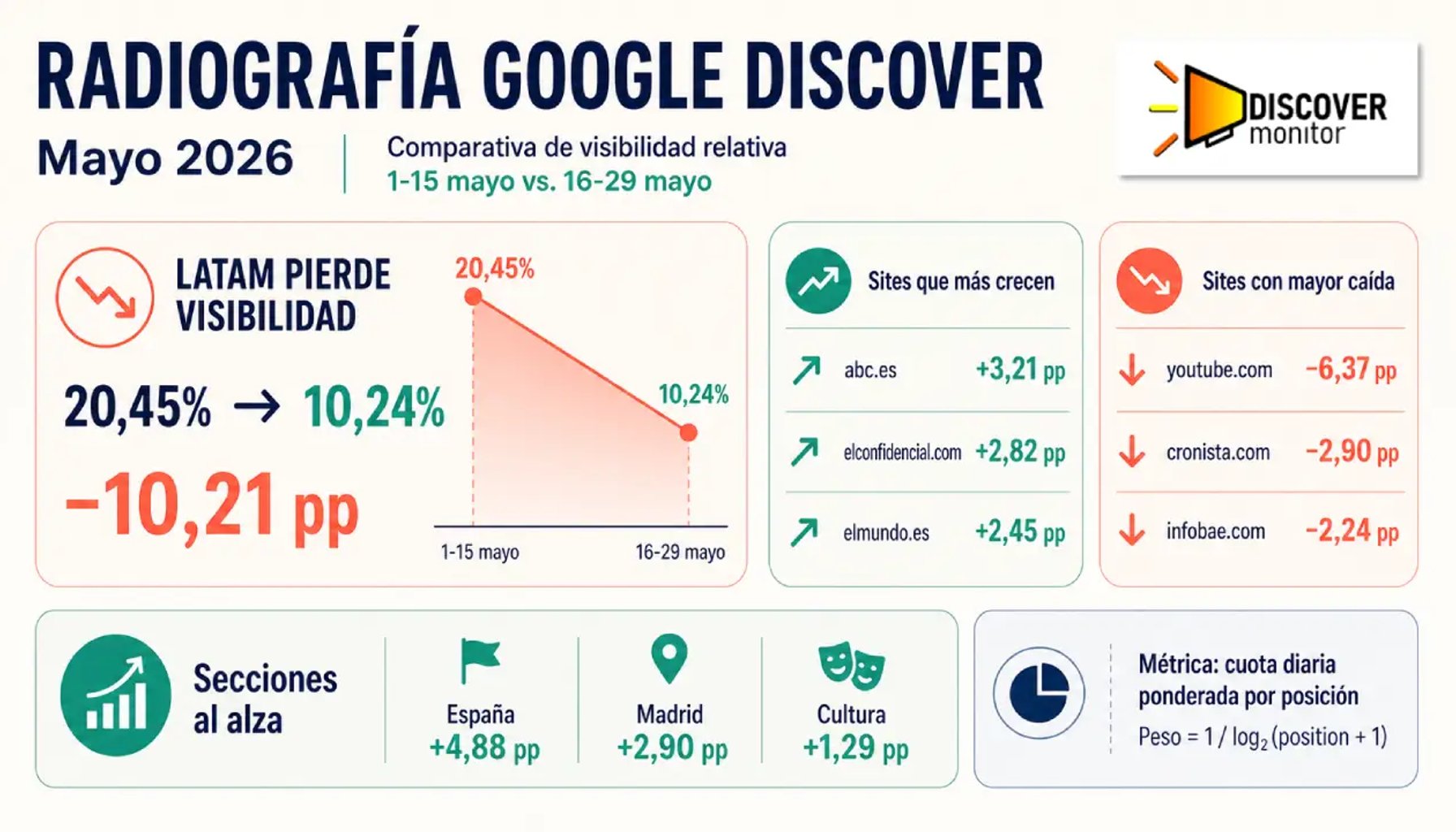
YouTube remains the domain with the highest visibility share. According to the analysis data, it goes from a 10.58% visibility in the first fortnight of May to 4.21% in the second fortnight, which represents a loss of 6.37 percentage points and a relative decrease of 60.2%. However, the most popular video platform on the internet remains one of the main domains on Google Discover.
What moderates is the visibility peak it had reached at the end of April and in the early days of May. Discover maintains the presence of video, but reduces its relative overexposure compared to traditional news media.
The "watch" category reflects exactly that same evolution: it drops from 10.58% to 4.21%. This reinforces the idea that the previous advance of video was highly concentrated on YouTube, and not necessarily a homogeneous expansion of all audiovisual formats. For the media, the data confirms that Discover's impulses can be very intense and also very brief. Strong growth over a fortnight does not guarantee a structural advantage if it is not consolidated across different categories, topics, and types of content.
LATAM momentum is cut in half
Another notable change of the month is the visibility of Latin American media in the Discover feed in Spain. Their aggregate share drops from 20.45% in the first fortnight to 10.24% in the second: it falls 10.21 percentage points and is practically cut in half.
The drop is clearly visible in several markets:
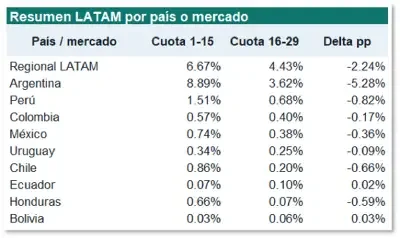
- Argentina, which was one of the blocks with the greatest weight, drops from 8.89% to 3.62%, with a loss of 5.28 percentage points.
- Peru falls from 1.51% to 0.68%
- Mexico drops from a 0.74% share to 0.38%
- Chile from 0.86% to 0.20%.
- Honduras drops from 0.66% to 0.07%.
By domains:
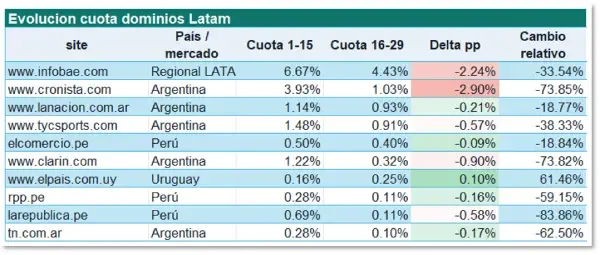
- Infobae maintains relevant visibility, although it drops from 6.67% to 4.43%.
- El Cronista registers a more pronounced drop, from 3.93% to 1.03%.
- Clarín drops from 1.22% to 0.32%
- La República from Peru falls from 0.69% to 0.11%.
The heavy LATAM weight observed at the beginning of May is not maintained with the same intensity in the second part of the month. Even so, their presence remains significant; Infobae continues to be among the domains with the highest visibility in the analysis. And several Argentine and Peruvian media retain a presence in the Spanish feed. Google seems to have corrected a moment of relative overrepresentation.
Spanish media recover prominence
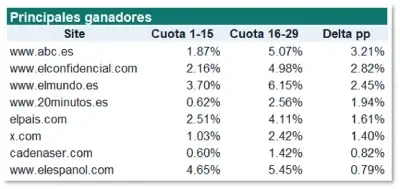
While YouTube and several LATAM media lose share, some Spanish media grow strongly:
- ABC is the biggest winner of the period: it goes from 1.87% to 5.07%, with an increase of 3.21 percentage points.
- El Confidencial advances from 2.16% to 4.98%, adding 2.82 points.
- El Mundo rises from 3.70% to 6.15%, with a growth of 2.45 points
- 20minutos also stands out, going from 0.62% to 2.56%
- El País, which rises from 2.51% to 4.11%
- Cadena SER, which grows from 0.60% to 1.42%
- El Español, which was already starting from a high position, and advances from 4.65% to 5.45%.
Domains with the highest visibility share in May 2026
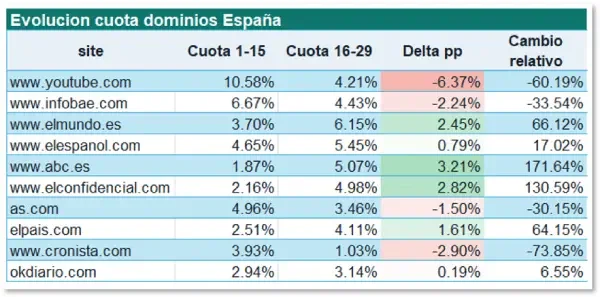
In the second half of May, among the analyzed domains, El Mundo positions itself as the site with the highest visibility share at 6.15%, followed by El Español with 5.45%.
Visibility is once again concentrated in generalist outlets capable of covering national news, politics, events, economy, sports, and other topics of high public interest.
National news gains weight: "Spain" and "Madrid" rise
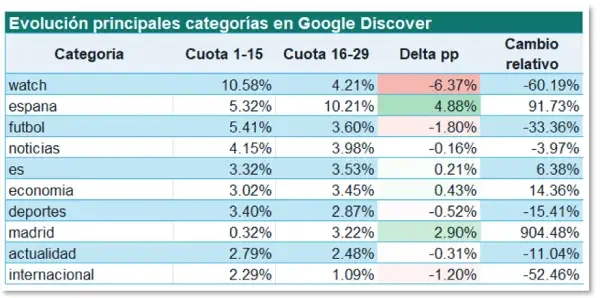
The category analysis also helps to understand the pattern change. The "Spain" category almost doubles its share, going from 5.32% to 10.21%. It is the largest thematic increase of the period, with a rise of 4.88 percentage points.
"Madrid" also stands out, going from 0.32% to 3.22%. Although starting from a very low base, the increase suggests a greater weight of local or regional topics with high traction during the second fortnight (the San Isidro festivities and political and corruption news may be responsible for this rise).
Conversely, "international" drops from 2.29% to 1.09%, while "football" falls from 5.41% to 3.60% and "sports" from 3.40% to 2.87%. The "news" category remains much more stable, with a slight decrease from 4.15% to 3.98%.
Overall, the second part of May seems more marked by Spanish current affairs and local news focuses. At the same time, some categories that had boosted the visibility of external domains, video, or international media lose relative weight.
X.com gains visibility, though far from YouTube's impact
It goes from 1.03% to 2.42%, with a rise of 1.40 percentage points. Its share remains far from that of the major media and YouTube, but the growth confirms that Discover also distributes content from other platforms. The presence of X may be related to the ability of certain publications, profiles, or conversations to activate around current affairs.
For editorial teams, the data serves as a reminder that Discover responds to the entirety of the informative conversation, not just a media outlet's original publication. Visibility can be influenced by the mentioned entities, conversations, social signals, formats, and editorial reaction speed.
What this analysis tells us about Google Discover
May's behavior leaves three conclusions:
- The first is that Discover changes rapidly. Relevant variations don't always take months to become visible; they can appear from one fortnight to the next. Analyzing short time windows helps detect impulses, corrections, and trend changes that would be diluted in monthly or quarterly reports.
- The second is that visibility peaks are not always structural. YouTube maintains a strong position, but its drop in the second half of May shows that a notable impulse can respond to a specific combination of current events, format, and engagement signals.
- The third is that Spanish media maintain a great capacity for recovery when the agenda is concentrated on national topics. The growth of El Mundo, ABC, El Confidencial, El País, El Español, or 20minutos shows that generalist outlets continue to play a central role in Discover when they connect with the current information demand.
The conclusion is that May normalizes the distribution of visibility after the April peak
The May 2026 analysis shows a clear redistribution of visibility in Google Discover Spain. YouTube remains a relevant domain, but it loses a large part of the extraordinary momentum it had received. The aggregate presence of Latin American media is cut in half, although some domains like Infobae retain an important share. At the same time, major Spanish media recover prominence, and several national categories gain weight.For editorial teams, the conclusion is clear: competing in Discover requires continuous measurement. It is not enough to know who dominates the feed at a specific moment. It is necessary to understand which domains rise, which lose momentum, which categories gain presence, and whether the changes respond to a structural trend or a cyclical peak.
Discover Monitor allows converting that volatility into comparable data, useful for making editorial decisions. When visibility can change in a matter of days, measuring by domains, categories, countries, and periods becomes a strategic necessity.