Google Discover is on the move again. After analyzing Discover Monitor data, pre and post the latest relevant change in Google’s algorithm, clear signs of visibility redistribution can be observed within the feed.
The main conclusion is that YouTube, some Latin American media outlets and, to a lesser extent, X/Twitter gained relative presence in Google Discover during the first half of May compared with the second half of April.
The analysis compares two time windows:
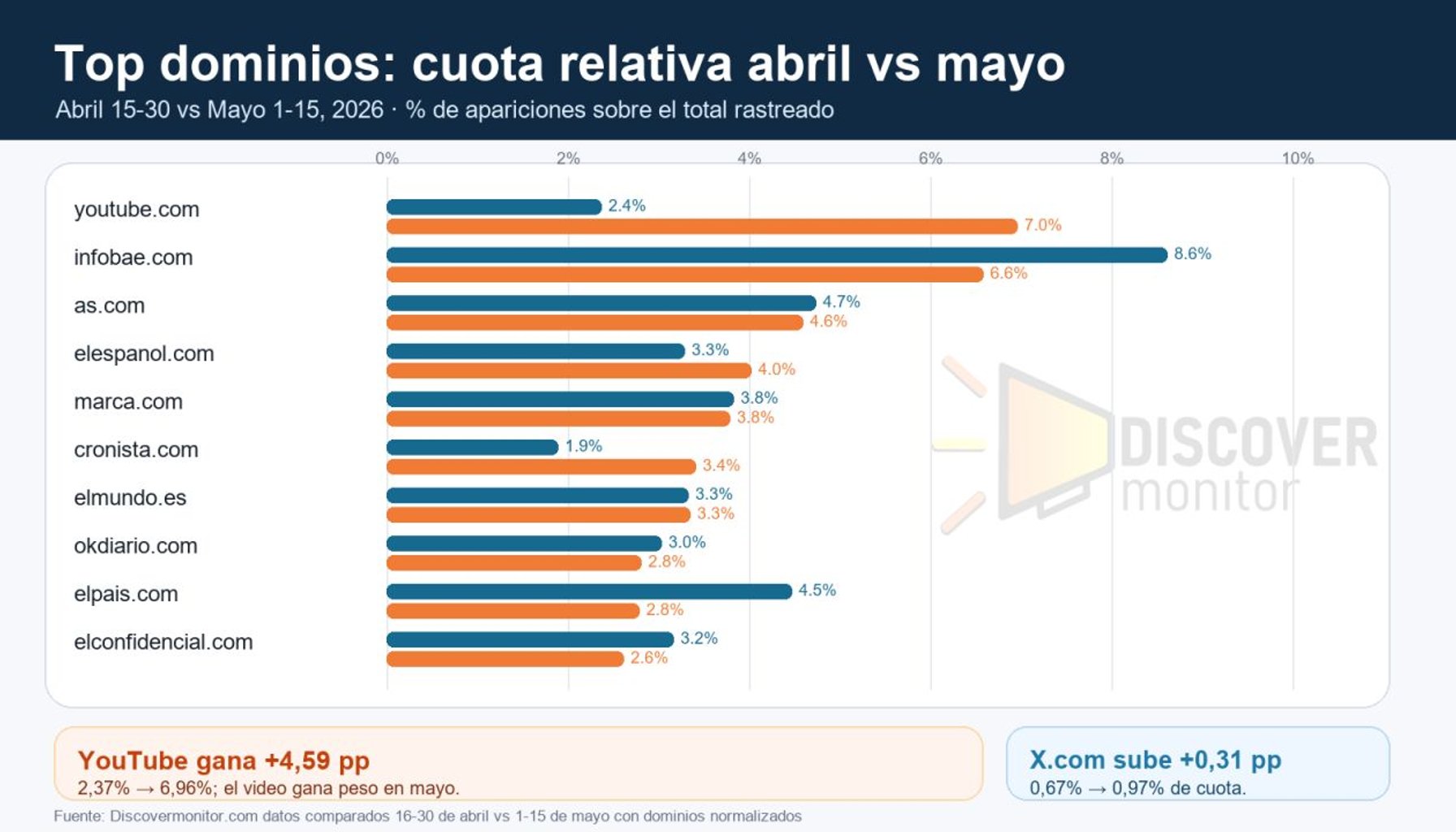
April 16-30 vs May 1-15, 2026
Although these data do not allow us to claim direct causality, they do show a significant change in the composition of the feed and in the type of domains capturing more appearances.
YouTube, the big winner of the period
The most striking movement is YouTube’s. According to the data analyzed, youtube.com goes from a relative share of 2.37% to 6.96%, representing an increase of +4.59 percentage points. In relative terms, it almost triples its presence within the set of tracked appearances.
This data points to a greater weight of video format within Discover, especially in contexts related to current events, entertainment, sports, and fast content consumption. This does not necessarily mean that Google Discover is becoming a video feed, but it does suggest that audiovisual content appears to have gained more space in certain topics and news moments.
X/Twitter also grows, although moderately
Another relevant change is the growth of X.com, although on a smaller scale.
Its share rises from 0.67% to 0.97%, with an increase of +0.31 percentage points. This is a moderate increase, but still significant because it shows that social platforms are gaining presence in Discover when they act as fast sources of updates or reactions to current topics.
Latin American media outlets gain visibility
One of the most interesting patterns in the analysis is the growth of Latin American media outlets, especially those from Argentina, Peru, and regional sports media. Overall, LATAM media gain +2.64 percentage points, representing a relative increase of 12.9% compared with the previous period.
The growth is not homogeneous. In fact, Infobae, which remains the largest Latin American media outlet in the dataset, loses share: it drops from 8.61% to 6.58%.
However, other domains gain significant weight. The most notable are:
- Cronista.com with an increase of +1.53 percentage points.
- Tycsports.com with an increase of +1.12 percentage points.
This suggests that Latin American growth does not depend solely on large generalist news brands, but also on specialized media outlets, sports verticals, and publications with a strong regional connection.
The feed remains highly concentrated
Beyond the changes between domains, the report confirms a key idea: Google Discover remains a highly concentrated environment. The top 10 domains with the highest visibility control 43.8% of the feed’s total visibility. In other words, a very significant share of appearances is distributed among a small group of players.
This concentration is relevant for editorial teams because it shows that Discover does not distribute visibility evenly. Brand authority, topical recurrence, editorial reaction capacity, and the connection with strong news entities continue to play a decisive role.
Current events, football, and freshness: the main drivers
The report also shows that the Discover feed is heavily shaped by current events.
61.4% of the detected content corresponds to breaking news or current events, with a median freshness of 13.6 hours since publication. This reinforces one of Discover’s main characteristics: it is not just an evergreen channel or a repository of recommended articles. In many cases, it works as a time-sensitive news consumption environment, especially when there are topics with high demand.
Among the dominant topics, the following stand out:
- Football, with a 9.5% share, driven by sports news and LaLiga events.
- Spanish current affairs, with 8.7%, consolidating itself as one of the main pillars of the feed.
These two blocks are complemented by YouTube’s growth, which appears to reinforce the presence of visual and fast-consumption content around major news topics.
What this means for media outlets
The data point to several operational conclusions for media outlets, publishers, and audience teams:
- Discover strongly rewards current events, especially when content is recent and connected to high-interest topics.
- Video is gaining more prominence, and YouTube appears as the main beneficiary of the period analyzed.
- The LATAM opportunity remains open, but it is not distributed evenly. Some regional and sports media outlets are capturing more visibility than large established news brands.
- The concentration of the feed makes it necessary to compete through authority and recurrence, not just by publishing a high volume of content. Domain, topic, brand, and connection with relevant entities seem to continue making a difference.
The latest Discover Monitor analysis shows a feed more dominated by current events, with a strong presence of football, Spanish news, and very recent content. But the most visible change is YouTube’s rise, almost tripling its relative share, and the growth of certain Latin American media outlets, especially Argentinian, Peruvian, and sports publishers.
Google Discover remains a volatile, concentrated ecosystem that is highly sensitive to current events. For media outlets, understanding these movements is not just a matter of reporting. It is a competitive advantage when deciding which topics to cover, when to publish them, and how to build editorial authority around the entities that are truly moving the feed.